
Your Go to Market Strategy Template That Works
Build a winning launch plan with our go to market strategy template. This guide offers actionable steps, real-world examples, and proven frameworks.
Your Go to Market Strategy Template That Works
A go to market strategy template is essentially your playbook for a successful product launch. It’s a simple document that gets everyone on the same page, outlining who you're selling to, how you'll actually reach them, and why your product is the only one they should be considering. It’s the tool that turns a brilliant idea into a business that works.
Why Your Launch Needs More Than a Good Idea
You know that feeling right before a product launch? It’s a cocktail of pure excitement and a healthy dose of sheer panic. I’ve been there. It’s so easy to get caught up in the moment and just shove your product out into the world, hoping its genius is obvious to everyone.
But launching on a prayer is like trying to drive across the country without a map. You’ll definitely end up somewhere, but it’s almost certainly not where you wanted to be.
This is exactly why a go-to-market (GTM) strategy template is your secret weapon. It forces you to ask—and answer—the hard questions before you launch, saving you from making expensive mistakes when it matters most.
From Concept to Customer Connection
Don't think of a GTM strategy as some stuffy corporate document. See it for what it is: your game plan for turning a great concept into a market hit. It’s the bridge between having a finished product and getting it into the hands of people who will happily pay for it.
Without that bridge, even the most amazing products can just sit there, gathering digital dust. Why? Because nobody knows they exist, or they just don't 'get' what makes them special.
A structured approach brings much-needed clarity to the most important parts of your launch:
- Your Target Audience: It helps you stop thinking about "everyone" and start focusing on a crystal-clear ideal customer profile.
- Your Market Positioning: It carves out your unique spot in what's probably a very crowded market.
- Your Messaging: It makes sure your marketing copy hits on real customer pain points, not just features.
- Your Channel Selection: It stops you from wasting money and directs your budget to the platforms where your audience actually spends their time.
A great idea gets you to the starting line. A great go-to-market strategy ensures you finish the race—and win. It's the difference between launching into the void and launching with purpose.
At the end of the day, a go to market strategy template just organises your thinking and your efforts. Forget all the dense business school theory. We’re talking about a practical tool to define who you're selling to, how you'll connect with them, and why they should pick you over the competition. This alignment is everything—it gets your sales, marketing, and product teams pulling in the same direction.
Pinpointing Your Ideal Customer and Market Position
Let’s be honest: who are you actually selling to? If your first thought is "everyone," we need to have a little chat. Trying to sell to everyone is the fastest way to sell to no one. The very foundation of a solid go-to-market plan is getting laser-focused on your audience. Without it, you’re just shouting into a crowded room, hoping someone listens.
This is where you need to build your Ideal Customer Profile (ICP). Think of it as a detailed blueprint of the perfect company that would get incredible value from your product. This isn't a person just yet; it's the organisational DNA of your dream customer—their industry, size, location, and even their business challenges.
Once you’ve got that down, you can create your buyer personas. These are the semi-fictional characters representing the real people inside those ideal companies—the ones who actually sign the cheques, use the product, and influence the decision. Getting this right is arguably the most critical first step in filling out your go to market strategy template.
ICP vs Buyer Persona: What's The Difference?
It’s incredibly common to mix these two up, but they play very different roles in your strategy. Your ICP tells you where to aim your efforts (which companies to target), while your buyer personas tell you who you're actually talking to and what they care about.
Here’s a quick breakdown to make it crystal clear.
| Aspect | Ideal Customer Profile (ICP) | Buyer Persona | | :---------- | :-------------------------------------------------------------- | :------------------------------------------------------------------------------ | | Focus | The company or organisation | The individual decision-maker | | Data | Firmographics (e.g., industry, company size, revenue, location) | Demographics & Psychographics (e.g., job title, goals, challenges, motivations) | | Purpose | To identify high-value target accounts and qualify leads | To guide messaging, content creation, and product development | | Example | A mid-sized tech company in Europe with 100-500 employees. | "Marketing Manager Maria," who is struggling to prove ROI on her campaigns. |
Nailing this distinction ensures your sales team isn't wasting time on the wrong companies, and your marketing team is creating content that truly connects with the people who matter.
This is all about narrowing your focus, moving from a massive, general market down to a specific customer you can truly serve.
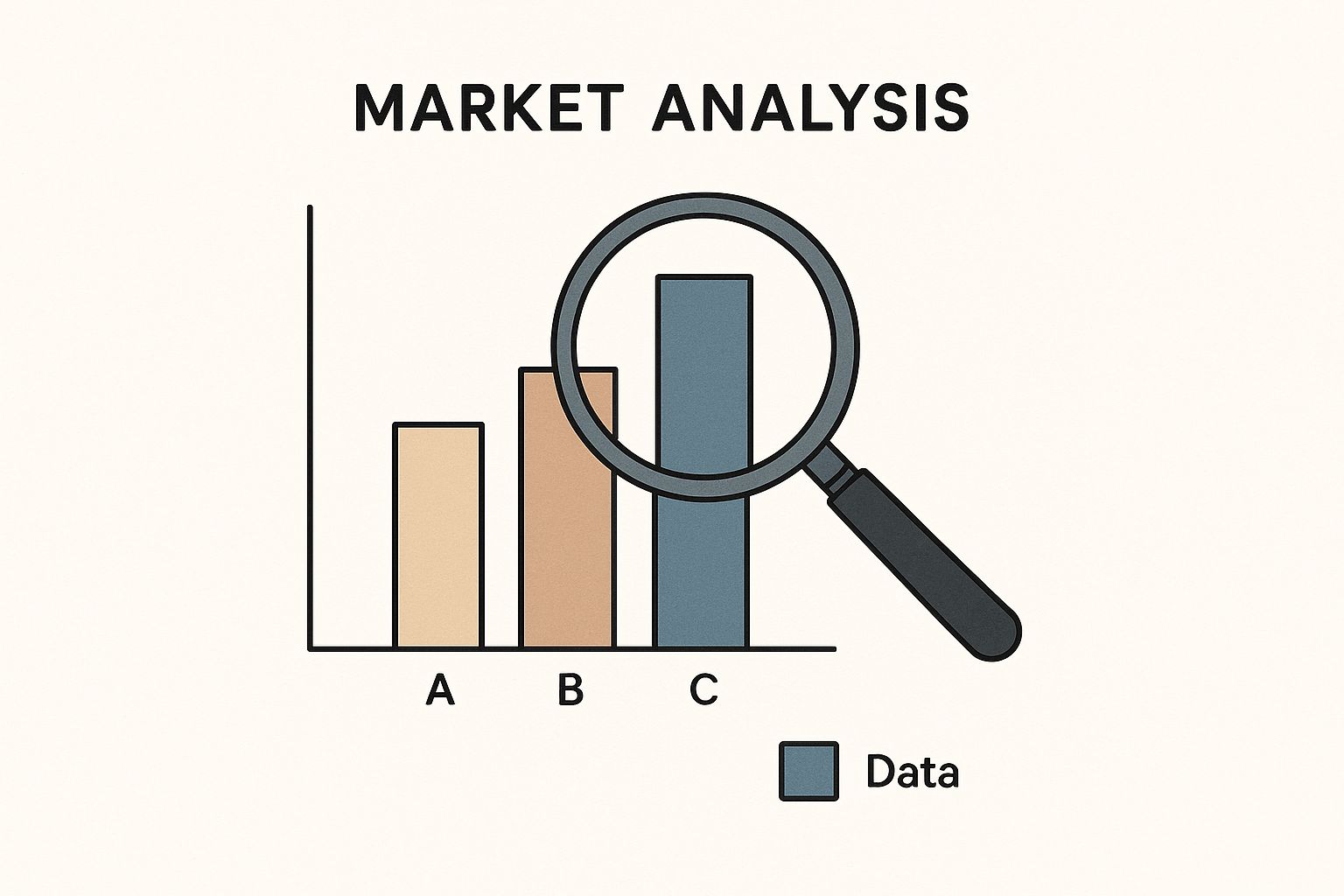
As you can see, a great GTM strategy is built on layers of research. You start broad and progressively drill down until you have a crystal-clear picture of your perfect customer.
Conducting Scrappy Market Research
Don't have a massive research budget? No problem. The best insights often come from simply talking to real people.
Find a handful of potential customers and just listen. Ask them about their day, their biggest headaches, and how they describe their problems in their own words. You'll learn more in a few of these conversations than you would from a thousand spreadsheets.
Another tip? Go hang out where your customers live online. Lurk in niche forums, LinkedIn groups, and subreddits related to your industry. What questions pop up over and over? What do they complain about? This is absolute gold for understanding their real pain points.
Your value proposition isn't what you think is cool about your product. It’s the clear, measurable result your customer gets from using it. It’s the answer to their unspoken question: "Why should I care about this?"
This kind of deep research is especially crucial in crowded or mature markets. Take the German software-as-a-service (SaaS) market, for instance. SaaS companies trying to win over German-speaking buyers absolutely must do this homework. Many GTM plans fail there because of a fuzzy audience definition or a weak analysis of the competition, which is a recipe for disaster with the region’s discerning buyers. You can learn more from these insights about the German SaaS market and GTM strategies.
Crafting Your Product and Pricing Strategy

Alright, you've figured out who you're selling to. Now comes the fun part: nailing down what you're actually selling and what it costs. It's so easy to fall into the trap of just listing all the cool bells and whistles your product has. But here's a hard truth: your customers don’t care about your features. They care about what those features do for them.
The trick is to connect the dots. Draw a straight, unmissable line from what your product does to how it makes your customer's life better. Instead of saying "automated reporting," show them the real-world win: "saves your finance team ten hours every single month." See the difference? That simple shift from features to benefits is everything. This section of your go to market strategy template is where you build the heart of your product's story.
Finding the Right Price Point
Let's be honest, pricing can feel like a bit of a dark art. It’s one of the toughest calls you'll make, and it’s tempting to just pull a number out of thin air that feels right. But your price is a massive signal to the market. It tells people about your brand, your confidence, and the value you’re promising. Get it wrong, and you either leave a pile of cash on the table or scare off the very people you’re trying to attract.
To get it right, you need a clear strategy. Here are the most common ways to approach it:
- Cost-Plus Pricing: This is pricing 101. You add up all your costs to build and sell the product, then stick a markup on top. It’s simple and ensures you make a profit, but it completely ignores what the market thinks your product is actually worth.
- Competitor-Based Pricing: You basically just have a look at what everyone else is charging and position yourself accordingly—a little higher, a little lower, or right in the middle. It's a decent starting point, but be warned, it can quickly turn into a race to the bottom on price.
- Value-Based Pricing: This is the gold standard. You price your product based on the tangible value it delivers to the customer. If you can prove your product saves them €10,000 a year, charging €1,000 for it doesn't just seem reasonable—it seems like a steal. This takes more work because you need to really get inside your customer's head.
Pricing isn't just about the numbers; it's a core part of your marketing. It tells a story. A low price screams "bargain," while a high price signals "premium quality." Make sure the story your price tells is the one you want customers to hear.
Let's Make This Real: A Pricing Example
Imagine you're launching a slick new project management tool specifically for small creative agencies.
If you go with a cost-plus model, you might calculate your server and support overhead and land on €29 per month. Safe, but uninspired.
Using a competitor-based model, you'd snoop around and find similar tools are hovering between €40-€60. So, you might decide to price yours at €45 to look like a solid, competitive option.
But what if you used value-based pricing? Through your customer research, you discover your tool saves the average agency five billable hours every month. If their standard rate is €100 an hour, your tool is handing them €500 in value. Suddenly, pricing it at €99 per month doesn't just feel justified; it feels like an incredible deal for them.
This is exactly why getting a handle on your value is so important. It completely changes the conversation from "How much does it cost?" to "Look at the return I'm getting!"—a much stronger position to be in.
Choosing Your Marketing and Sales Channels
https://www.youtube.com/embed/XQVQJmcNlcI
So, you’ve got a fantastic product and you know exactly who you’re selling to. Now comes the million-dollar question: how do you actually reach them? This is where your go to market strategy template starts to get real, moving from high-level plans to on-the-ground action. It's time to pick the marketing and sales channels that will bridge the gap between your solution and your customer's problems.
The biggest mistake I see companies make is what I call the "spray and pray" approach. They scatter their budget across every channel imaginable—Facebook ads, SEO, TikTok, email marketing—just hoping something sticks. This doesn’t just burn through your cash; it waters down your message and exhausts your team.
The goal is to be strategic, almost surgical. You need to zero in on the handful of channels where your ideal customers are actually spending their time and are most likely to listen. Think about it: if you’re selling high-end financial software to CFOs, a targeted campaign on LinkedIn or in specialist industry newsletters is going to be far more effective than a flashy Instagram campaign. The latter would be a complete waste of money.
Aligning Your Marketing and Sales Funnel
Your channels aren't islands. They need to work in concert to guide someone from being a complete stranger to a loyal, paying customer. A thoughtfully planned channel mix creates a smooth, intuitive path for your buyers.
-
Awareness (Top of Funnel): This is all about getting on their radar. Channels like SEO, content marketing (think helpful blog posts and guides), and targeted social media ads are your best friends here. You’re not going for the hard sell; you’re offering value and positioning your brand as a credible expert.
-
Consideration (Middle of Funnel): Okay, they know you exist. Now you need to build on that initial interest. This is the perfect time for things like email marketing, webinars, and detailed case studies. You’re building trust and showing them exactly how your product solves their specific pain points.
-
Decision (Bottom of Funnel): It’s time to seal the deal. This is where your sales process really kicks in, whether that involves product demos, free trials, or direct calls from your sales team. It's critical that the marketing messages leading up to this point align perfectly with what the sales team is saying.
A seamless customer journey feels effortless to the buyer but is the result of deliberate strategy. When your marketing promises what your sales team delivers, you create a powerful, trust-building experience that drives conversions.
Picking the Right Channels for Your Audience
Let's get practical. How do you actually decide where to focus? Go back to your buyer persona. Where do they hang out online? Where do they go for information, and whose opinions do they trust?
Let’s take a real-world example: a B2B SaaS company trying to sell to project managers in Germany. Digital trends are a massive factor in any GTM plan for this region. With an online penetration rate of about 93.5% and social media use at 77.6%, you can't ignore digital channels. Email marketing, for instance, has surprisingly high engagement rates in Germany compared to other countries. As digital ad spending continues to climb, basing your GTM plan on solid data like this gives you a huge advantage. You can dig into more of Germany's digital marketing trends and what they mean for your business to get a clearer picture.
For our B2B SaaS company, a smart, focused channel mix might look like this:
- Content Marketing & SEO: Creating in-depth articles on project management challenges to attract people searching for solutions on Google.
- LinkedIn Ads: Precisely targeting users with the job title "Project Manager" within specific industries and company sizes.
- Email Marketing: Offering a valuable downloadable guide to build a subscriber list, then nurturing those leads with useful content.
- Direct Sales Outreach: A more hands-on approach for those high-value target accounts you identified during your ICP research.
This focused strategy ensures every euro is working hard to reach the right person, with the right message, at exactly the right time.
Measuring Success with the Right Metrics
So, how do you actually know if your launch is working? It's all too easy to get caught up in fuzzy ideas like "increased brand awareness," but let's be honest—feelings don't pay the bills. This section of your go to market strategy template is where you define what success looks like in cold, hard numbers.
If you don't have clear metrics, you're essentially flying blind. You won't know which parts of your plan are hitting the mark, what's just a money pit, or when it's time to pivot. A data-first approach creates a vital feedback loop, letting you turn real results into smarter decisions down the road.
Moving Beyond Vague Goals
It’s time to ditch the fluffy stuff. We need to focus on the Key Performance Indicators (KPIs) that really matter to the health of your launch and, ultimately, your business.
Here are a few metrics I always keep a close eye on:
- Customer Acquisition Cost (CAC): In simple terms, how much do you have to spend to get one new customer? You calculate this by dividing your total sales and marketing spend by the number of new customers you brought in.
- Customer Lifetime Value (LTV): This is the total amount of money you can realistically expect a single customer to spend with you over their entire relationship with your brand. It’s a huge indicator of long-term viability.
- Lead-to-Customer Conversion Rate: Of all the qualified leads you generate, what percentage actually pull out their wallets and become paying customers? This KPI tells you a lot about the effectiveness of your sales process.
- Sales Cycle Length: How long does it take, on average, to turn a curious prospect into a happy customer? Knowing this helps you forecast revenue and spot any friction in your funnel.
If you take away just one thing, let it be this: your LTV must be significantly higher than your CAC. A good rule of thumb is to aim for an LTV to CAC ratio of at least 3:1. If it costs you €100 to land a customer who only ever spends €50, you have a serious problem with your business model.
Setting Realistic Targets and Budgets
Once you've nailed down your core KPIs, you need to set some achievable targets for your launch period. This isn't the time for wishful thinking. Look at industry benchmarks, your own historical data (if you have it), and be brutally honest about what you can achieve with your budget and team.
Here's a practical example. Let's say your goal is to acquire 50 new customers in your first three months. If you've set a target CAC of €200, then you immediately know you'll need to allocate at least €10,000 to your marketing and sales budget to have a realistic shot at that target.
Doing this turns your GTM plan from a wish list into a proper, measurable roadmap for growth. It gives you the power to track your performance in real-time, see what's working, and make smart adjustments to your strategy as you learn.
Bringing Your GTM Launch Plan to Life
Alright, this is where the theory ends and the real work begins. So far, your go-to-market strategy template is a collection of brilliant ideas, solid research, and thoughtful decisions. Now it's time to turn that document into an actual, actionable launch plan your team can run with.
Think of this as your pre-flight checklist. Every single piece of the puzzle—your ideal customer, your pricing, the channels you've picked—needs to slot together perfectly. We're not just making a to-do list; we're creating a clear, chronological roadmap that takes you from here to a successful launch day.
Nailing Down Ownership and Timelines
A plan is just a wish until someone owns it. The first thing you absolutely have to do is assign a clear owner to every major task. Who’s on the hook for the final website copy? Who’s managing the ad spend? The moment you put a name next to a task, accountability goes through the roof.
Once you have your owners, you need to work backwards from your launch date to set deadlines that are actually achievable. Be honest with yourself here. You have to account for unexpected delays, your team's current workload, and anything that depends on outside partners. A timeline that’s too tight is just asking for burnout and sloppy work.
Here’s a simple way to lay this out in your template:
- Key Initiative: Finalise Pre-Launch Email Sequence
- Owner: Sarah (Marketing)
- Due Date: 15 October
- Dependencies: Needs final messaging approval from James.
- Key Initiative: Set Up LinkedIn Ad Campaigns
- Owner: Tom (Paid Media)
- Due Date: 20 October
- Dependencies: Needs creative assets from the design team.
This super simple format instantly turns big ideas into concrete actions people can get behind.
A beautiful strategy on paper is worthless without great execution. The whole point of this action plan is to build clarity and momentum, making sure everyone on the team knows exactly what they need to do to make the launch a success.
Setting Up a Regular Review Cadence
A launch plan isn’t something you write and then file away. The market is always shifting, your assumptions will be challenged, and you'll learn things on day one that force you to adapt. That’s why setting up a regular check-in is non-negotiable. A quick, 30-minute sync-up each week can be the difference between success and failure.
This isn't about micromanaging people. It's a chance for the team to:
- See how you're tracking against the timeline.
- Spot and clear out any roadblocks.
- Share early results and what you're learning.
- Make quick decisions based on real data, not guesswork.
This approach keeps you agile, allowing you to pivot when you need to, instead of just sticking to a plan that clearly isn't delivering. The international angle is a huge factor here, too. For instance, if you're targeting Germany, Europe's largest economy, your GTM plan has to be built on a foundation of intense market research and localisation. A successful entry into the German market often comes down to adapting your product and marketing to local tastes and navigating strict regulations. For German consumers who value quality and tradition, things like brand positioning and channel selection are critical. You can learn more about what it takes by reading up on building a successful market entry strategy for Germany.
By turning your strategic template into a real launch plan—with clear owners, realistic timelines, and a review process—you’re no longer just hoping for a great launch. You’re engineering one.
I'm Jackson Ly. CTO, founder, and someone who believes in helping people exceed their limits through technology and business. Learn more about what I'm building at jacksonly.xyz.