
How to Conduct Market Research: Your Essential Guide
Learn how to conduct market research effectively with our step-by-step guide. Discover tips to gather valuable insights and make informed decisions.
How to Conduct Market Research: Your Essential Guide
Before you spend a single penny or minute on market research, you’ve got to ask the right questions. It all comes down to a pretty straightforward process: figure out your goal, pick your methods, grab the data, find the patterns, and then actually do something with what you've learned. This early groundwork is the difference between a heap of useless stats and a genuine, game-changing insight for your business.
Why Smart Research Always Starts with Clear Goals
Before you dream up a single survey question or book an interview, you need to know exactly what you're trying to figure out. Fuzzy goals like "I want to understand my customers better" will only get you fuzzy, unusable answers. You have to get specific.
Think of it like planning a road trip. You wouldn't just get in the car and start driving without knowing where you're going, right? Your research objective is your destination. It steers every decision you make along the way and makes sure every bit of information you collect has a real purpose. Honestly, getting this first part right is the most critical step in learning how to do market research that actually works.
Nail Down Your Core Objective
What’s the one big question you absolutely need an answer to right now? Are you trying to see if your product idea will even fly? Wondering if your current customers are happy? Or maybe you need to figure out where you stand against the competition?
For example, I once worked with a startup that was stuck debating between two completely different target markets for their new app.
Instead of a broad, generic goal, they got laser-focused. Their objective was: "Determine which user segment—freelancers or small agency owners—has a higher willingness to pay for our core features." Boom. That one sentence immediately gave their entire research plan a clear direction.
A truly solid objective is always:
- Specific: It zooms in on a single, well-defined problem.
- Measurable: You can tell when you've found the answer (e.g., identifying the group with a 15% higher price tolerance).
- Actionable: The results will directly help you make a concrete business decision.
Get Clear on Your Audience and Competitors
Once your objective is locked in, you can start figuring out who you need to talk to. For that startup, it meant building out distinct profiles for both freelancers and agency owners. Who are these people? Where do they spend their time online? What keeps them up at night?
At the same time, you need to size up your main competitors. Don't just make a list—dig in and analyse them. What are their customers griping about in online reviews? What holes can you spot in their product offerings? This initial competitive scan can highlight some golden opportunities before you even start collecting fresh data.
A well-defined objective acts as a filter. It helps you instantly separate the merely interesting data from the essential data, stopping you from chasing down rabbit holes that don't lead anywhere.
For instance, if you're looking at the German market, it's not enough to just know your direct rivals. Proper market research there has to consider wider trends like demographic shifts and new government regulations, especially in booming areas like digital health and sustainable materials. Germany’s massive focus on eco-friendly products, partly driven by its huge timber reserves, is a perfect example of how consumer preferences are shifting—a key insight for anyone trying to enter that market. It's worth reading more about the German market landscape to really grasp these finer points.
Getting this foundation right—defining your 'why', pinpointing your audience, and understanding the competitive lay of the land—is what ensures every piece of data you gather will directly fuel your strategy.
How to Choose Your Research Methods
Alright, you've got your objectives nailed down. Now for the fun part: figuring out how you're actually going to get the answers you need. When it comes to gathering intel, you've really got two main routes you can go down: primary research and secondary research.
Think of it like this: primary research is like being a chef and cooking a meal entirely from scratch. You're sourcing fresh, raw ingredients (data) directly from the source (your audience) to create something brand new and perfectly suited to your taste.
Secondary research, on the other hand, is like using high-quality, pre-made ingredients. Someone else has already done the heavy lifting of preparing them. It's faster and often cheaper, but it wasn't created specifically for your unique recipe.
The best approach? It's almost always a blend of both.
This image gives a great visual breakdown of how the two stack up against each other when you look at the cost, time, and the kind of results you can expect.
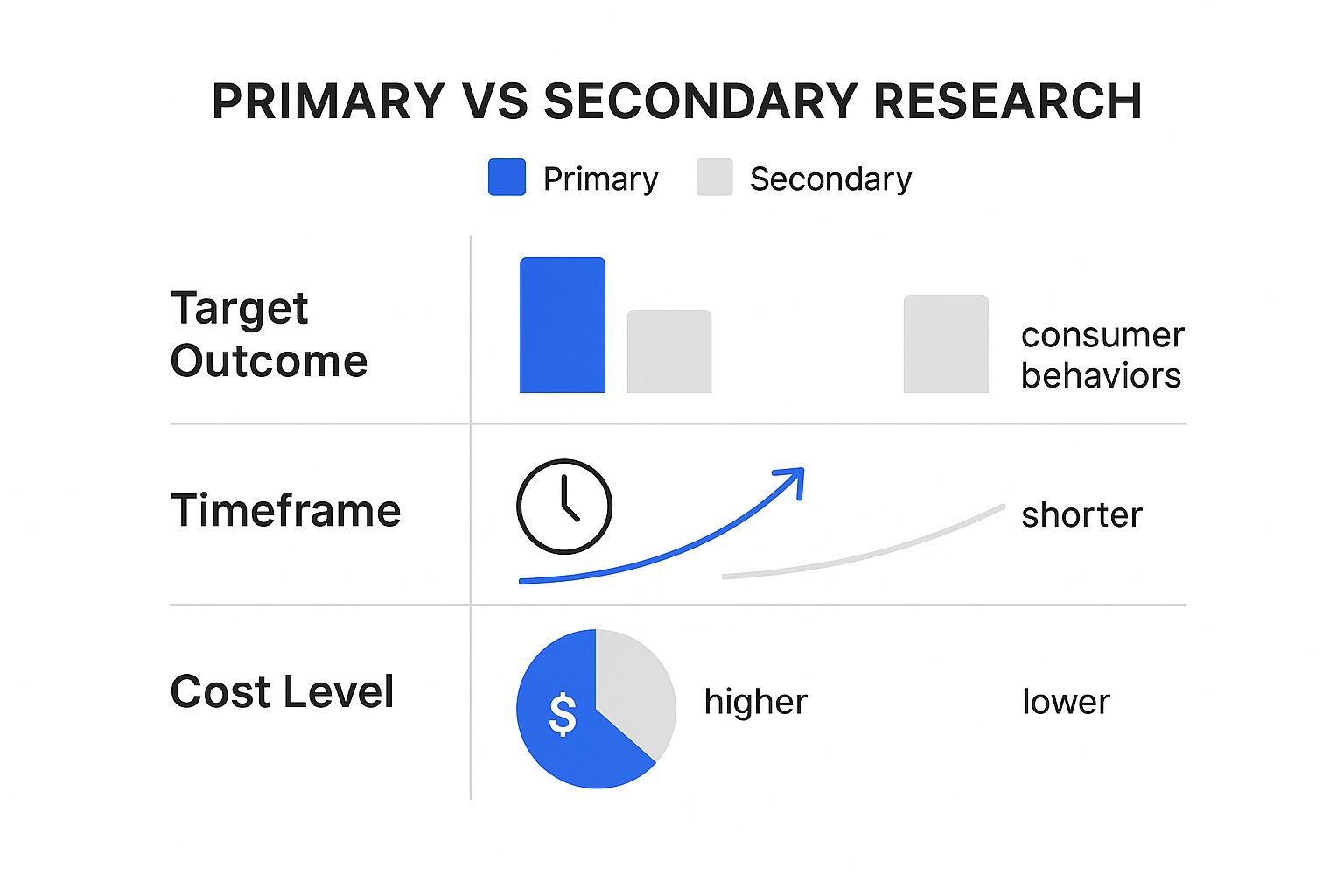
As you can see, if you're after deep, custom insights, primary research is your ticket, but be prepared for the investment in time and money. Secondary research is brilliant for getting a quick, affordable snapshot of the broader market.
To help you decide which path (or combination of paths) is right for you, here’s a quick comparison.
Primary vs Secondary Research Methods
| Method Type | What It Is | Best For | Potential Drawback | | :------------ | :--------------------------------------------------- | :----------------------------------------------------------------------------------------- | :------------------------------------------------------------------------- | | Primary | Collecting new, original data directly from sources. | Answering very specific questions about your customers and validating your unique ideas. | Can be time-consuming and more expensive to carry out properly. | | Secondary | Using data and information that already exists. | Getting a broad understanding of the market, trends, and competitors quickly. | The information is available to everyone and might not be specific enough. |
Ultimately, your choice depends on your specific goals, the budget you're working with, and how quickly you need answers. Most strong research plans start with secondary to get the lay of the land, then move to primary to fill in the crucial gaps.
Digging for Gold with Primary Research
So, when do you roll up your sleeves and get into primary research? You do it when you have burning questions that a Google search simply can't answer. This is about generating data that is tailored specifically to your business and your goals.
Some tried-and-true methods I always come back to are:
- One-on-one Interviews: There's nothing quite like sitting down (even virtually) and just talking to a customer. It's perfect for digging deep into their real motivations and frustrations. The best insights often come from follow-up questions you never even planned to ask.
- Surveys: These are your best friend for gathering quantitative data from a much larger group. Tools like Google Forms or SurveyMonkey make it incredibly easy to see patterns and trends emerge from a crowd.
- Focus Groups: Getting a small group of 6-8 people together in a room can be magical. The discussion can uncover group dynamics and social influences that you’d completely miss in a one-on-one chat. This is fantastic for getting reactions to a new ad campaign or product concept.
The real beauty of primary research is that the data is all yours. Your competitors can't see these specific insights about your audience, giving you a serious edge. It's especially powerful for understanding the nuances of the user experience, which is why having the right customer journey mapping tools is so important for visualising what you learn.
Standing on the Shoulders of Giants: Secondary Research
Before you even think about drafting a survey or scheduling interviews, you absolutely must see what's already out there. Starting with secondary research is not just smart; it's the most efficient way to get your bearings.
Don't underestimate the power of a good desk research session. You can often answer 70-80% of your initial questions this way, which lets you save your precious primary research budget for the stuff you really need to know.
So, where do you find this treasure trove of existing information?
- Government Reports: Government agencies are constantly publishing incredibly detailed demographic and economic data. The best part? It's usually completely free.
- Industry Publications: Think trade journals, market analysis reports, and industry blogs. These are packed with trends, statistics, and expert opinions that give you context.
- Your Competitors' Homework: Seriously, analyse their websites, read their annual reports (if public), and dive into their customer reviews. You'll learn a ton about their strategy and, more importantly, where their customers are feeling pain.
The obvious catch with secondary research is that it wasn't made for you. It's available to everyone, and it might be too broad to solve your specific problem. But what it will do is provide a solid foundation and help you ask much, much smarter questions when—and if—you decide it’s time to move on to primary research.
Actually Gathering Your Data

Alright, you've got your plan locked in. Now comes the fun part: rolling up your sleeves and actually collecting the information. This is where all the theory about how to conduct market research becomes a real, hands-on process.
Your main goal here is to gather high-quality, unbiased information. Seriously, the quality of the data you collect at this stage will make or break your final decisions, so it's mission-critical to get it right.
Crafting Surveys That People Actually Answer
Surveys are brilliant for gathering data from a lot of people at once, but let's be honest, a badly written one is worse than useless—it can point you in completely the wrong direction. The real secret is to make your questions clear, concise, and sound like they were written by a human.
You absolutely have to avoid leading questions. Don't ask something like, "Don't you agree that our new feature is amazing?" That just nudges people to agree with you. Instead, try a more neutral approach: "How would you describe your experience with our new feature?"
Here are a few tips I've picked up over the years:
- Start with the easy stuff: Ease people in with simple questions (like demographics) before you get to the heavy-hitting topics.
- One idea per question: Never cram two ideas into one question, like "Was our product easy to find and affordable?" Split them up. People get confused and you get messy data.
- Give them an 'out': Always include options like "Not applicable" or "I don't know." Otherwise, you'll get people picking random answers just to get through the survey, which skews your results.
A tool like SurveyMonkey can help you build surveys with a clean, user-friendly interface that doesn't overwhelm your audience.
Notice the clear progress bar and simple question formats in the image? Those are best practices for keeping people engaged and stopping them from abandoning your survey halfway through.
Running Interviews to Uncover 'Aha!' Moments
If surveys give you the "what," then one-on-one interviews are where you discover the "why." This is your chance to hear the stories, frustrations, and brilliant ideas straight from your audience.
The key to a great interview? Listen more than you talk. Your job is to guide the conversation, not control it. I always go in with a list of open-ended questions, but I'm fully prepared to ditch the script and follow an interesting tangent if one pops up.
The most valuable insights often come from the follow-up question you never planned to ask. When a participant says something interesting, simply ask, "Can you tell me more about that?" and see where it leads.
Reaching Your Audience in the Digital World
Let's be real: finding people to participate is often the biggest headache. This is especially true when you're trying to conduct market research in a digitally savvy region like Germany, where understanding online behaviour is everything.
Consider this: roughly 90% of Germans are online, and over 80% are active on social media. Digital channels aren't just an option anymore; they're the main stage for data collection. And with a massive 95.1% of these social media users on their phones, your surveys and outreach absolutely must be optimised for mobile.
This digital-first reality means online surveys and social media analytics will often give you a far more accurate picture of the German market than old-school methods. If you're targeting this region, it’s worth digging into the key trends shaping Germany's digital marketing landscape to sharpen your strategy.
Nailing this data collection phase gives you all the raw material you need for that big breakthrough you're looking for.
Finding the Story in Your Data
https://www.youtube.com/embed/TEqYnV6KWfY
You’ve done the hard work. You’ve gathered all the information, and now you’re staring at a spreadsheet that’s a sea of numbers, or a document crammed with interview notes. This is where the real work begins. Raw data is just noise; the magic happens when you find the story within it.
This is the analysis stage. Think of yourself as a detective. You’re not just crunching numbers; you're looking for clues, connecting dots, and uncovering the patterns that tell you what’s really going on in your market.
From Raw Data to Actionable Insights
First things first, you need to get organised. If you're working with quantitative data from surveys, start by cleaning up your spreadsheet. From there, create some simple charts—bar graphs, pie charts, whatever works. Seeing the data visually is often the fastest way to spot an obvious trend. You’ll immediately see which feature everyone is asking for or which pricing plan is the clear winner.
Qualitative data from interviews or focus groups requires a more hands-on approach. I like to start by grouping similar comments and observations into themes. You can create simple categories like “Common Frustrations,” “Things They Love,” or “Feature Wishlist.” This helps you zoom out from individual comments to see the bigger picture.
Your goal isn't just to report what people said; it's to uncover the 'why' behind their words. When three different interviewees mention a competitor's confusing checkout process, the insight isn't "the competitor is confusing"—it's "there's a market opportunity for a simpler checkout experience."
Connecting the Dots and Avoiding Pitfalls
With everything organised, you can start piecing things together to answer your original research questions. Look for the obvious patterns, sure, but don't ignore the outliers. Sometimes the most powerful insights come from that one person whose feedback goes against the grain.
This is also where you have to be brutally honest with yourself and watch out for your own biases. Confirmation bias is a killer. It’s that sneaky tendency to only see the data that proves what you already wanted to be true. To fight it, actively play devil's advocate. Ask yourself, "What would it look like if I was wrong?" and then genuinely search for that evidence in your findings.
This kind of rigour is non-negotiable, especially when you’re dealing with complex market data. For instance, in Germany's fast-moving real estate investment market, a headline figure like €14.2 billion in transaction volume for the first half of the year doesn't tell you much on its own. Digging deeper reveals that while the average deal size dropped, mid-size deals were actually picking up steam. For a researcher, that’s the real story—it shows the need to break down the findings by deal size and region to give clients advice that’s actually useful. You can see more on these German investment market trends at CBRE.
Ultimately, good analysis always ties back to the bottom line. If you've found a major customer pain point, how much is solving it worth? Connecting your research to financial metrics is key. If you're in SaaS, our guide on the LTV/CAC ratio for SaaS startups is a great place to start linking these worlds together.
This is how your market research stops being a report and starts being a powerful tool for making smart business decisions.
Putting Your Research Into Action

Let's be honest: even the most brilliant research is useless if it just collects digital dust in a folder somewhere. The whole point of learning how to conduct market research is to turn those hard-won insights into actual, tangible action. This is where your analysis sparks real change.
Your goal isn't to create a hundred-page report that nobody will ever read. It's to build a simple, compelling story that makes your findings impossible to ignore and gets your team fired up to do something about it.
Crafting a Compelling Data Story
Your team doesn’t need a deep dive into every single data point you gathered. What they need is to understand what it all means. The best way to get the message across is by telling a story with your data, focusing on the handful of takeaways that directly answer your original questions.
Visuals are absolutely your best friend here. Think about it: a simple bar chart showing that 78% of users prefer one feature over another packs a much bigger punch than a sentence buried in a dense paragraph.
Use things like charts and graphs to:
- Highlight key comparisons: A side-by-side view of customer preferences or a competitor’s weak spots is incredibly effective.
- Illustrate trends: A line graph can instantly show if a particular customer concern is growing over time.
- Make numbers stick: Pull out the most shocking or important statistics and give them the spotlight.
Keep your report brief, make it visual, and always focus on the "so what?" behind every piece of data.
From Analysis to Actionable Recommendations
Alright, this is where the rubber meets the road. Every key finding you present needs to be paired with a clear, concrete recommendation. Don't just point out a problem—propose a solution and use your data to back it up.
The most effective research reports don't just present information; they build a powerful case for a specific course of action. Your job is to connect the dots from "Here's what we learned" to "Here's exactly what we should do next."
For instance, if your research uncovers a massive opportunity in a new market segment, your recommendation should be the first concrete step in a larger plan. This is how your findings directly shape business strategy. In fact, your research can become the foundation for a robust plan, similar to the insights you'd build into a comprehensive go-to-market strategy template.
So, instead of a vague suggestion like, "We should probably improve our marketing," a strong, data-driven recommendation sounds more like this:
- Finding: "Our interviews revealed that target customers in the creative industry are constantly frustrated by our competitor's overly complex pricing."
- Recommendation: "Let's develop and test a simplified, three-tier pricing model aimed specifically at creative agencies. We can get this done within the next quarter."
This approach turns your research from a simple academic exercise into a practical roadmap for growth. By presenting clear, data-backed recommendations, you ensure all that hard work actually leads to smart business decisions and gives you a real edge.
Common Market Research Questions
Alright, you've got your plan mapped out, but a few nagging questions are probably still bouncing around in your head. It happens to everyone when they're getting started with market research. Let's tackle some of the most common queries I hear all the time.
How Much Does Market Research Really Cost?
Honestly? The cost can be anything from £0 to tens of thousands of pounds. It really just comes down to how deep you need to go.
If you're a startup on a shoestring budget, you can get a surprising amount done for free. Seriously. You can tap into government data for your secondary research and use tools like Google Forms to run surveys without spending a penny. This is the perfect way to get solid answers to your most burning questions right out of the gate.
The costs start creeping in when you need to scale or get more specific. Think paying for access to a panel of survey respondents, bringing in a professional moderator to run your focus groups, or subscribing to a powerful analytics platform. The trick is to always start with the lowest-cost methods that deliver the biggest bang for your buck.
So, How Long Does This Process Take?
This is another "how long is a piece of string?" question. The timeline is completely dependent on the scope of your project.
For instance, you could whip up a quick survey, send it to your email list, and have genuinely useful data back in a week. From there, you could analyse the findings and have clear actions to take just a few days later.
But if you're planning a massive deep-dive—let's say it involves a series of in-depth interviews, crunching data from multiple sources, and a full competitive analysis—you could easily be looking at a few months from start to finish. That’s why it’s so important to set a realistic timeline right at the beginning, so everyone involved knows what to expect.
The goal isn't speed; it's clarity. A week-long project that gives you one crystal-clear, actionable insight is infinitely more valuable than a three-month study that ends with a vague "maybe". Figure out your objective first, then build a timeline that serves that goal.
Is Market Research the Same as Marketing Research?
They sound almost the same, and they're definitely related, but they do different jobs. It’s a small difference in name but a big one in practice.
Think of market research as drawing the map of the entire playing field. It's all about understanding the big picture—the total size of your market, who the major players are, and what your potential customers truly need. It's how you figure out where you fit.
Marketing research, on the other hand, is much more tactical. It’s about checking if your specific marketing moves are actually working. Are people responding to that new ad campaign? Which pricing model gets the best reaction? Is our brand message even landing?
To put it simply, one helps you understand the world you're operating in, while the other helps you make smarter moves within it.
I'm Jackson Ly. CTO, founder, and someone who believes in helping people exceed their limits through technology and business. Learn more about what I'm building at jacksonly.xyz.